


Introduction to Modern Agricultural Technology
Agriculture is rapidly evolving with the help of advanced technologies like drones and artificial intelligence (AI). Traditional farming methods are no longer enough to meet the growing food demand and environmental challenges faced by modern agriculture. Farmers now need faster, smarter, and more efficient ways to manage crops, monitor fields, and increase productivity.
Drones and AI are transforming agriculture by improving decision-making, reducing labor costs, and helping farmers achieve higher yields with fewer resources.
What Are Agricultural Drones?
Agricultural drones are unmanned aerial vehicles (UAVs) designed specifically for farming activities. These drones are equipped with cameras, sensors, GPS systems, and spraying equipment that help farmers monitor and manage crops from the air.
Unlike traditional field inspections, drones can cover large farming areas quickly and provide detailed real-time information about crop conditions.
Role of Artificial Intelligence in Farming
Artificial intelligence in agriculture refers to the use of computer systems and machine learning technologies to analyze farming data and make smart decisions.
AI systems can process information from sensors, drones, weather forecasts, and satellites to help farmers improve irrigation, pest control, fertilizer management, and harvesting schedules.
Instead of relying only on experience and guesswork, farmers can now use accurate data to optimize farming operations.
Crop Monitoring with Drones
One of the biggest advantages of drones in agriculture is crop monitoring. Drones equipped with high-resolution cameras can capture detailed images of fields from above.
These images help farmers identify unhealthy plants, water stress, nutrient deficiencies, and pest infestations before the damage spreads.
Early detection allows farmers to take quick action, reducing crop losses and improving overall yield.
Drone-Based Spraying Systems
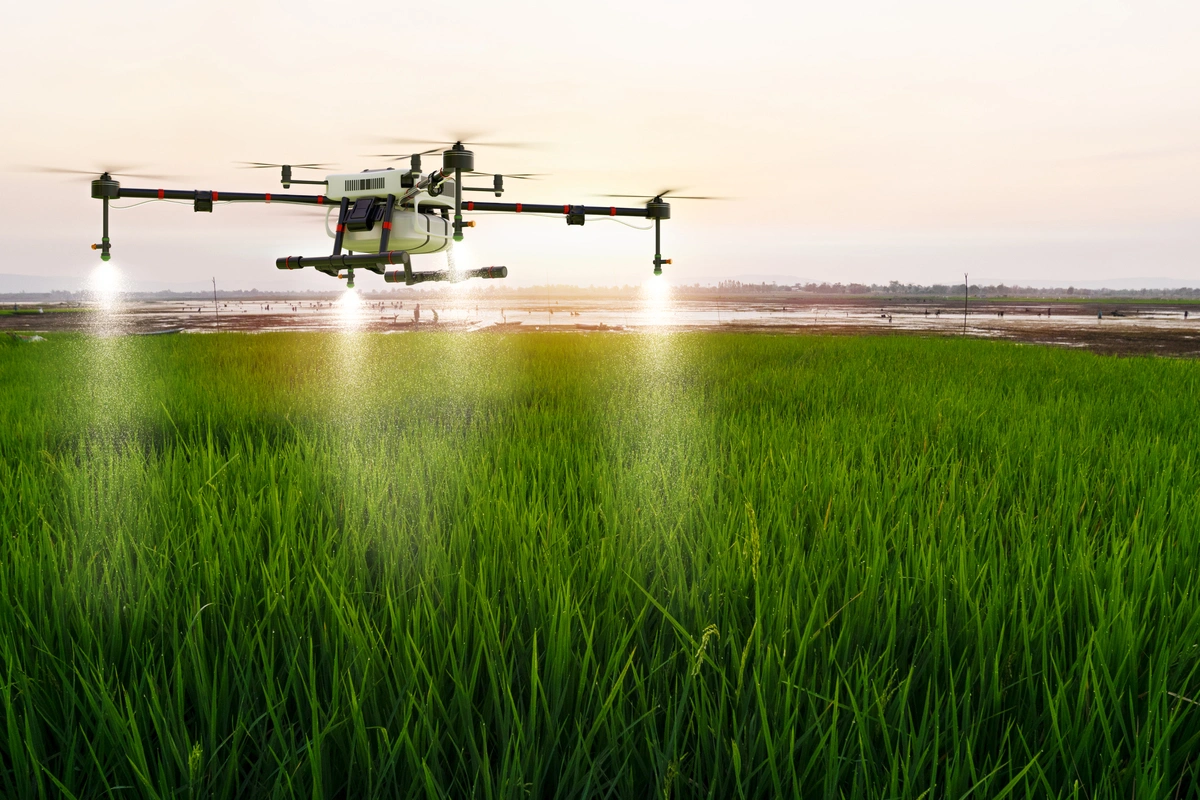
Modern agricultural drones are also used for spraying pesticides, fertilizers, and herbicides. Drone spraying is faster and more precise compared to manual spraying methods.
Drones can target specific areas instead of spraying the entire field, reducing chemical wastage and environmental pollution.
This technology is especially useful in large farms and difficult terrains where manual spraying is time-consuming and labor-intensive.
Soil and Field Analysis Using Drones
Before planting crops, drones can help analyze soil conditions and field variations. Special sensors detect moisture levels, soil health, and elevation differences.
This information helps farmers plan irrigation systems, choose suitable crops, and apply fertilizers more effectively.
Accurate field analysis improves resource management and supports precision agriculture practices.
AI-Powered Pest and Disease Detection
Artificial intelligence systems can identify plant diseases and pest attacks by analyzing images captured through drones and cameras.
Machine learning algorithms compare crop images with disease databases and provide instant diagnosis. This helps farmers treat problems at an early stage before they spread across the field.
AI-based disease detection reduces unnecessary pesticide use and protects crop health more efficiently.
Smart Irrigation Systems
Water management is one of the biggest challenges in agriculture. AI-powered irrigation systems use sensors and weather data to determine when and how much water crops need.
Drones and AI together help monitor soil moisture and detect dry areas in the field. This allows farmers to irrigate only where necessary, reducing water wastage.
Smart irrigation systems improve crop growth while conserving valuable water resources.
Yield Prediction with Artificial Intelligence
AI technology can predict crop yields by analyzing weather patterns, soil conditions, plant health, and historical farming data.
Yield prediction helps farmers plan storage, transportation, labor requirements, and market strategies in advance.
Accurate forecasting also reduces financial risk and improves farm management decisions.
Weed Detection and Management
Drones and AI are making weed control more efficient. Cameras and AI software can distinguish between crops and weeds with high accuracy.
This allows farmers to apply herbicides only on weed-infested areas instead of the entire field.
Targeted weed management reduces chemical costs and minimizes environmental impact.
Livestock Monitoring with Drones and AI
In addition to crop farming, drones and AI are also used in livestock management. Drones help monitor animal movement, grazing patterns, and herd health.
AI systems can analyze animal behavior and detect signs of illness or stress early.
This improves animal welfare and helps farmers manage livestock more efficiently.
Benefits of Drones in Agriculture
Drones provide several advantages in modern farming:
• Faster field monitoring
* Reduced labor requirements
* Precise pesticide and fertilizer application
* Early detection of crop problems
* Improved decision-making
* Better resource management
* Reduced operational costs
These benefits help farmers improve productivity while saving time and money.
Benefits of AI in Agriculture
Artificial intelligence improves farming through:
• Data-driven decision-making
* Accurate weather forecasting
* Smart irrigation management
* Disease prediction and prevention
* Yield estimation
* Reduced input waste
* Improved farm efficiency
AI systems help farmers make smarter and more profitable farming decisions.
Challenges of Using Drones and AI
Despite their benefits, drones and AI also have some challenges. High initial investment costs can make adoption difficult for small farmers.
Technical knowledge is required to operate drones and interpret AI-generated data correctly.
Battery limitations, internet connectivity issues, and maintenance costs can also affect efficiency in rural areas.
Future of AI and Drones in Agriculture
The future of agriculture will become increasingly automated and data-driven. AI-powered robots, autonomous tractors, and advanced drone systems are expected to become common in farming operations.
Future technologies may allow fully automated crop monitoring, spraying, harvesting, and farm management with minimal human involvement.
As technology becomes more affordable, even small farmers will have easier access to smart farming solutions.
Importance for Sustainable Farming
Drones and AI support sustainable agriculture by reducing excessive use of water, fertilizers, and pesticides.
Targeted farming practices reduce environmental pollution and help maintain soil health over the long term.
Efficient resource management also supports climate-smart farming and long-term food security.
Use of Drones and AI in Pakistan Agriculture
In Pakistan, the adoption of drones and AI in farming is growing steadily. Large farms are increasingly using drones for crop monitoring and pesticide spraying.
Government organizations and agricultural startups are also promoting smart farming technologies to improve productivity and water management.
As awareness increases, more farmers are expected to adopt digital agriculture tools in the coming years.
Conclusion
Drones and artificial intelligence are changing the future of agriculture by making farming smarter, faster, and more efficient. From crop monitoring and disease detection to smart irrigation and yield prediction, these technologies help farmers improve productivity while reducing costs and environmental impact.
Although challenges like investment and technical skills still exist, the long-term benefits of drones and AI make them essential tools for modern farming. Farmers who adopt these technologies early will be better prepared for the future of agriculture.